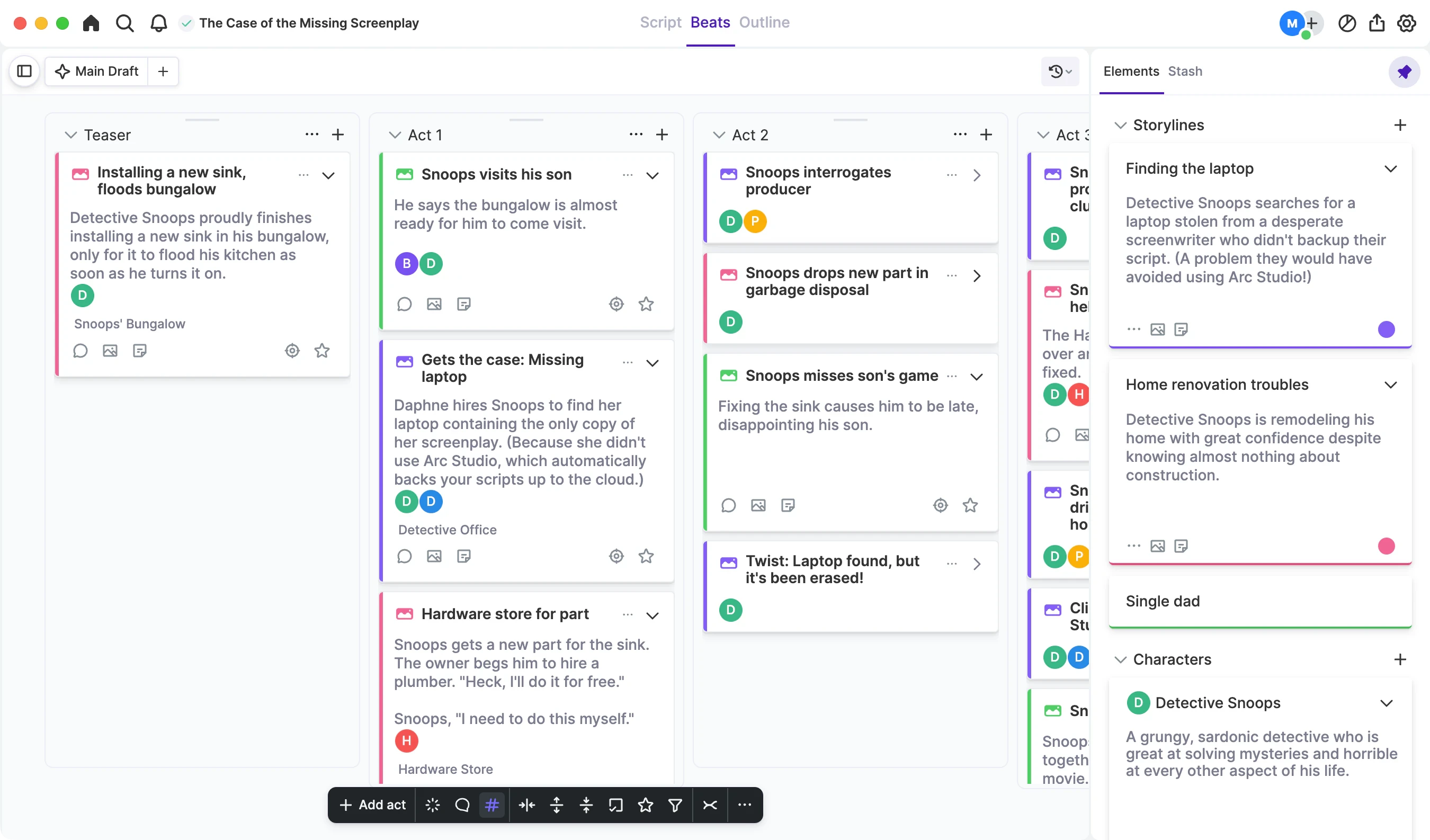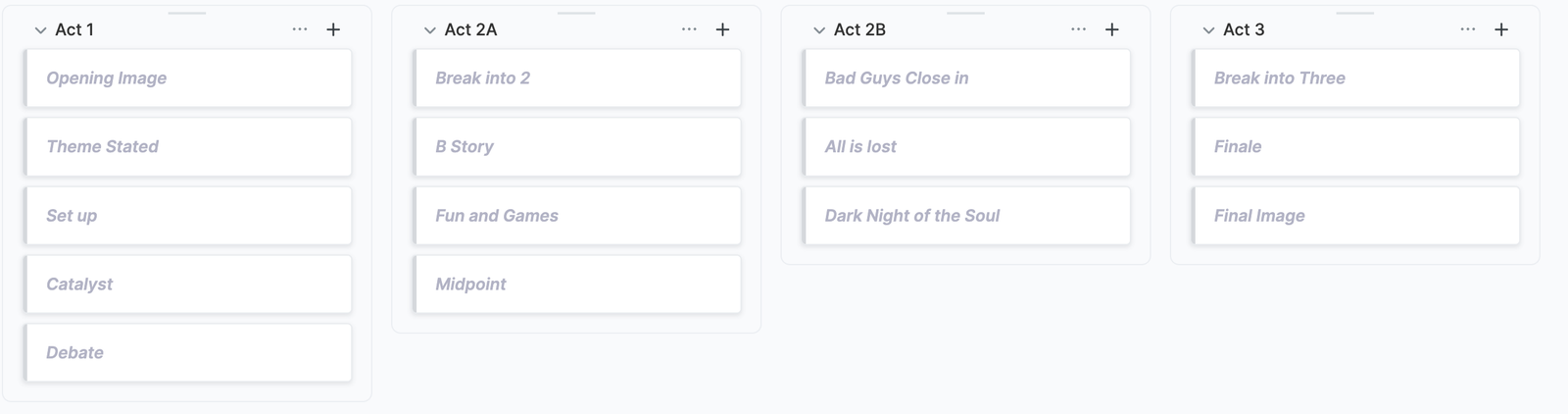
Plot board screenshot of Save the Cat
Save the Cat is the most famous storytelling structure by far. The book proved to be a massive financial success leading many to believe that Save the Cat is the default structure of all stories. Without a doubt, Save the Cat is an ideal place for a beginner and functions as a great introduction to storytelling.
Beats
Act 1:
- Opening Image: A strong thematic image to start.
- Theme Stated: At some point near the beginning, the theme of the script is stated.
- Set-Up: Plot work to set-up the rest of the story.
- Catalyst: The incident that sets the adventure in motion.
- Debate: The protagonist is reluctant to begin their journey.
Act 2A:
- Break into Two: A plot point (often a change in location) that indicates the adventure has begun.
- B Story: A secondary story begins, often a love interest.
- Fun and Games: The promise of the premise. If this is an action movie, have your best action setpiece here.
- Midpoint: A plot point that raises the stakes and changes the direction of the story.
- Bad Guys Close In: The antagonistic force applies pressure on the protagonist.
- All is Lost: The protagonist fails in a gambit and is sent spiralling.
- Dark Night of the Soul: An introspective moment where the protagonist wonders how they got to where they are.
Act 3
- Break into Three: A thematic or plot revelation spurs the protagonist forward, reinvigorating them.
- Finale: The final setpieces where the story concludes.
- Final Image: The final image of the screenplay.
Pros and Cons
Pros
- Simple and clean. There’s no fluff and everything has a clear purpose in the layout.
- Offers a strong introduction to storytelling structure.
- Allows the intrepid screenwriter to rewatch films they’re familiar and better understand how their favourite stories function.
Cons
- A little too didactic. In the book, Snyder is adamant that plot points must fall on specific pages. This can lead to a lot of hamstrung screenplays.
- Lacks nuance. Unlike some other structures, Snyder has no interest in exploring why these beats are organized like this. This makes the whole idea feel arbitrary.
- Save the Cat only accounts for mainstream Hollywood movies (though, not unanimously). Try applying Save the Cat to something out of the mainstream and you’re going to have a lot of trouble.
Difficulty Level: Easy
Use Case: If you’re just starting out, writing a screenplay while using Save the Cat can help you grasp the basics and churn out a story that has a strong backbone.
A paperback version of Save the Cat by Blake Snyder book can be found on Amazon here.