It doesn’t matter if you have an awesome story and captivating characters. A script with weak scenes is like a brick wall built out of red sponges. It’s not gonna do the things a wall needs to do.
In the post I’m going to share the two biggest secrets to writing compelling scenes that will keep readers captivated.
Secret #1: Your scene needs to have a point
Before you write your scene, you need to think about what the point of it is. Why does this scene need to be in your script? The point could be to show a character is still in love with their ex, or for the detective to find the next clue, or a million other things depending on what your story is.
But if you can’t think of a good reason for this scene to be in your script, if the scene doesn’t really have a point, cut the scene.
Congratulations, your script is already stronger. Cutting the scenes that don’t need to be there helps the others shine.
But if the scene does have a point, keep that point firm in your mind as you’re writing and check in to make sure you’re actually staying on point and not going off on some tangent.
Secret Number #2: David Mamet’s Three questions
The second secret to great scenes is a three-parter. It’s David Mamet’s Three Questions to ask about every scene:
- Who wants what?
- What happens if they don’t get it?
- Why now?
Our scripts are driven by what our characters want. That’s true for the whole story, but also for individual scenes. The character wanting something motivates the scene. It’s tied into the point of the scene. So ask yourself who wants what in your scene. If no one wants anything, the scene is probably going to feel slow and lifeless.
The next question, what happens if they don’t get it? speaks to what we call stakes. What are the consequences of failure? When there are consequences, there is a lot more urgency and power in the scene, because it matters if they succeed or fail. If it doesn’t matter, then who cares?
Why now? Speaks to the urgency of the scene. What has prompted this? Why are we dealing with it now?
Having strong answers to these questions will help make the scene dramatic. Mamet wrote:
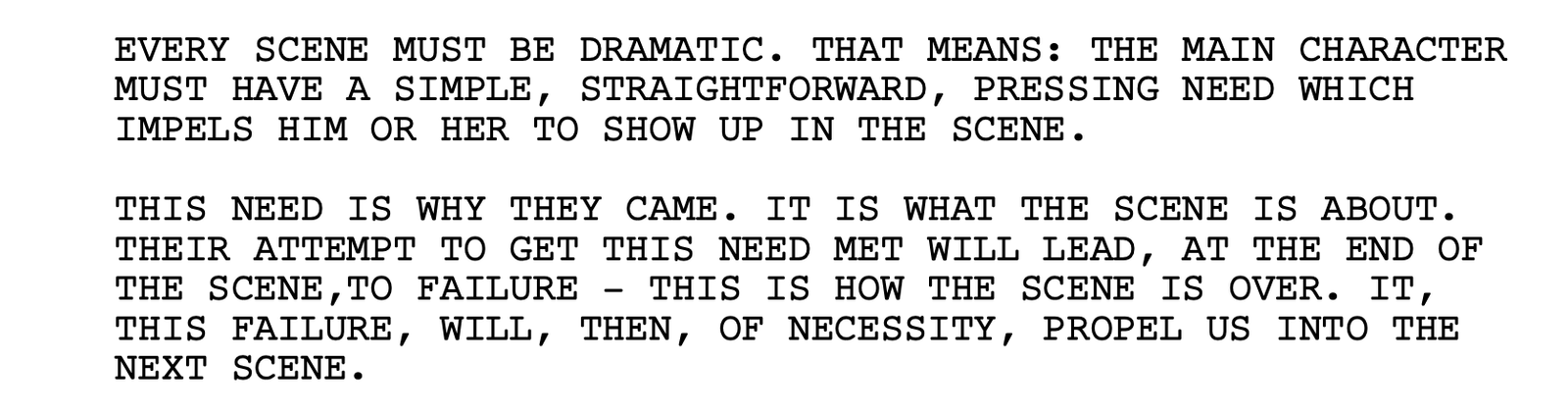
David Mamet on scenewriting.
The awesome thing about this approach is not only does it make your scenes more compelling, but it also gives you the key to structuring your scenes.
Because your scenes, like your story, have a beginning, a middle, and an end. And those three parts match up with that quote from Mamet.
The scene begins because the character has “a simple, straight forward, pressing need which impels him or her to show up in the scene.”
The middle of the scene is “the attempt to get this need met.”
And the scene ends with their failure to get what they need, which then propels us into the next scene.
Does it always need to end in failure? At least partially, unless it’s the end of the story, because they still need to want something else for there to be a next scene. Or it could be a failure in the sense they wanted one thing, but they got something else.