Out of all the little eccentricities that make up screenplay formatting, none is looked over more than the humble parenthetical. However, using parentheticals can be crucial pieces of the screenwriter's toolbox that can significantly affect the production of a script and the reader's enjoyment.
What is a parenthetical?
The word "parenthetical" might ring some bells, even if you haven't tried screenwriting before. There's a good reason for that. Luckily, your English teacher probably drilled it into your head a long time ago when you were learning how to use grammar in day-to-day English writing.
A parenthetical is a fancy way of saying "brackets" like these (). In day-to-day writing, parentheticals are used to convey a bit more information pertinent to the attached sentence, but there wasn't enough room in the sentence to squeeze it in (like this). A parenthetical can also be used around a plural letter in a word like "the screenwriter(s) life," indicating that either reading of the sentence is correct.
In other words, a parenthetical is a way of squeezing just a bit more contextual information into a sentence. For example, if written language is about communication, the parenthetical is about pushing in just a little more information before it's too late.
How does a parenthetical work in a screenplay?
Like day-to-day writing, a parenthetical is most often used to put a little bit more information into a screenplay. It's always used in a dialogue block, just below the character name but above the actual dialogue.
Here's a parenthetical I used in my most recent screenplay:
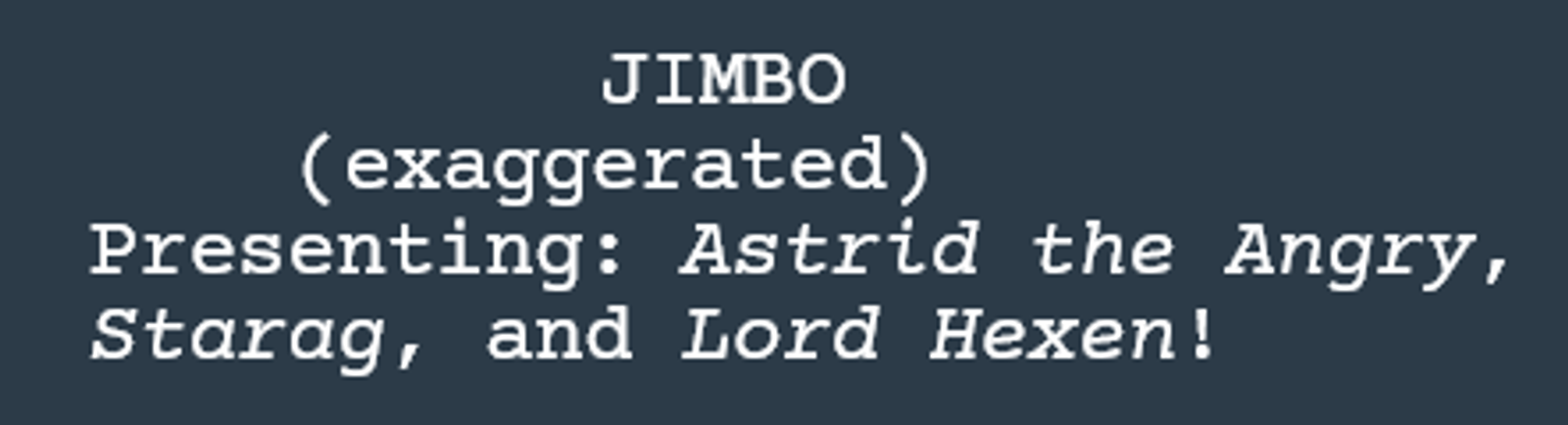
Without the parenthetical, we might think that Jimbo is delivering the line in a serious or angry manner. Unfortunately, there are vague points in the English language that need cleaning up. For example, when I wrote that line, I knew I had pictured the character saying it in a certain way, but the way the line was written didn't reflect that intention.
So, instead of changing the line itself, I just inserted a parenthetical "(exaggerated)" to indicate that Jimbo is intentionally over the top in his delivery. This eliminates confusion on the reader's part and helps get my intention across as quickly as possible.
A parenthetical doesn't just have to be an adjective that changes how a line is delivered. If a character is talking with an entire group, but you want to make sure they say their line directly at a single person and not the group at large, you can use a parenthetical to indicate that.
Here's another example from my screenplay:
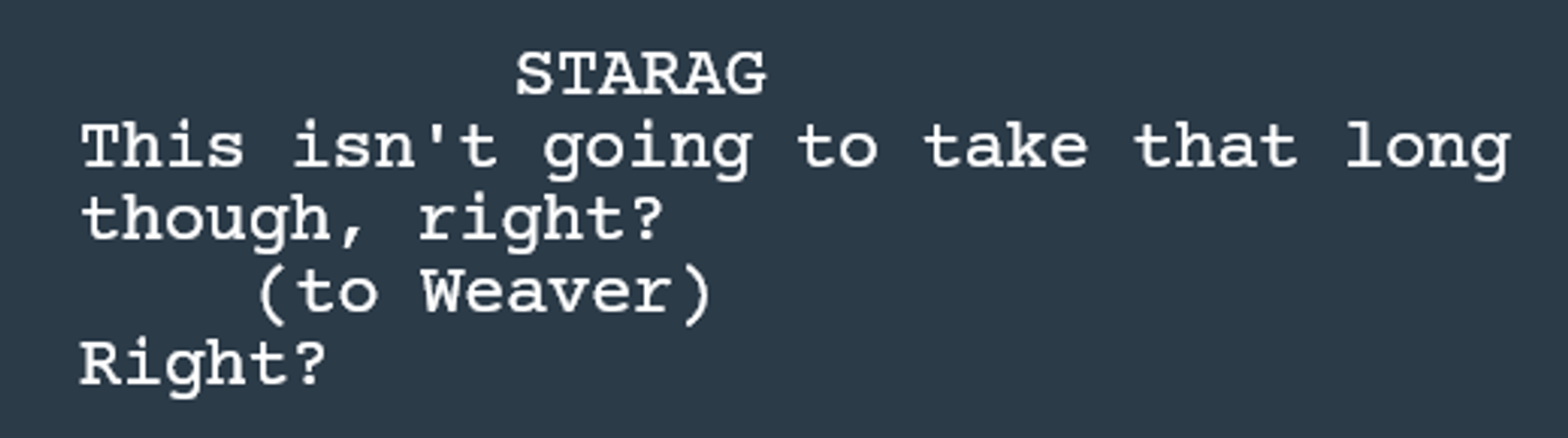
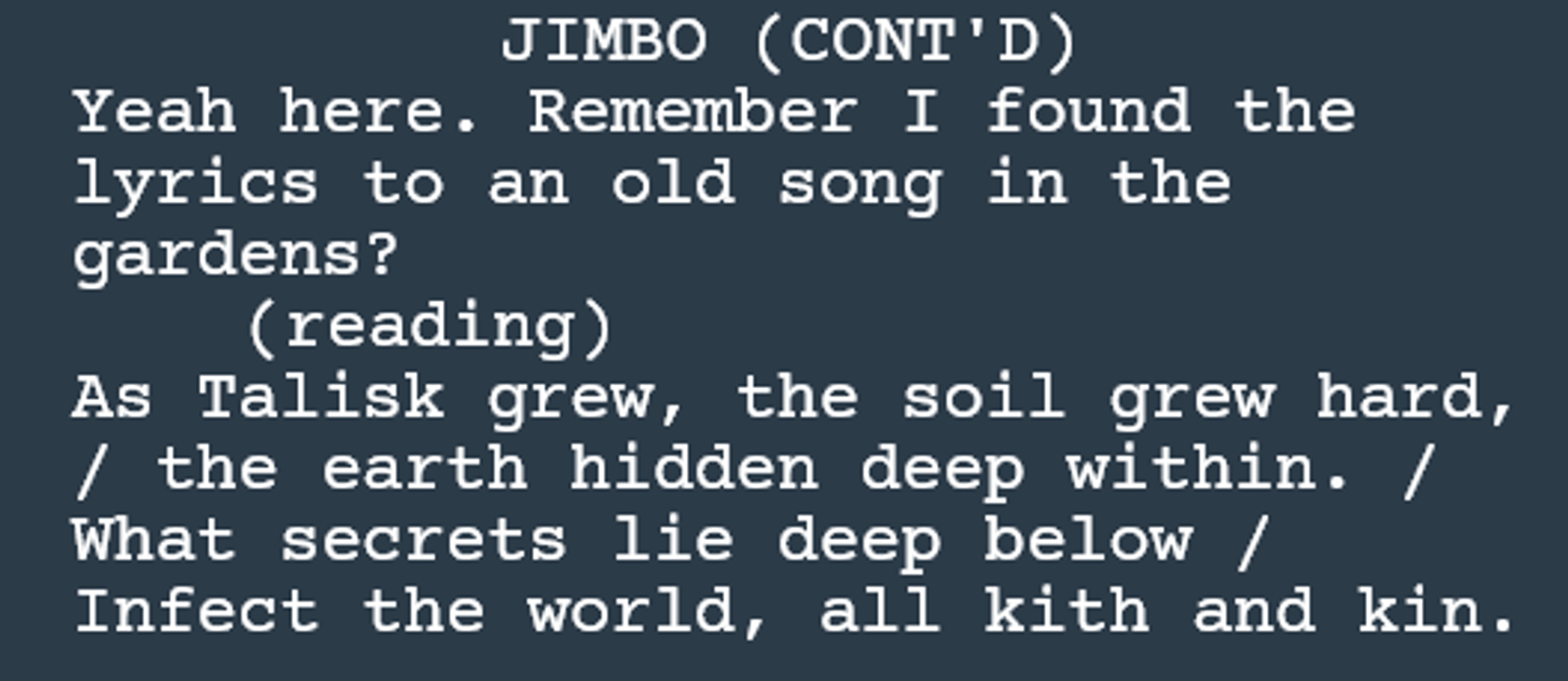
A parenthetical can also indicate when a character does something small during their dialogue, but the action isn't so important that it requires a break into an action line. Usually, this is some motion or a tiny body language change that may change the meaning and delivery of the lines. Here's another example from the same screenplay that indicates a character has started reading something off a page, so their line delivery would change.
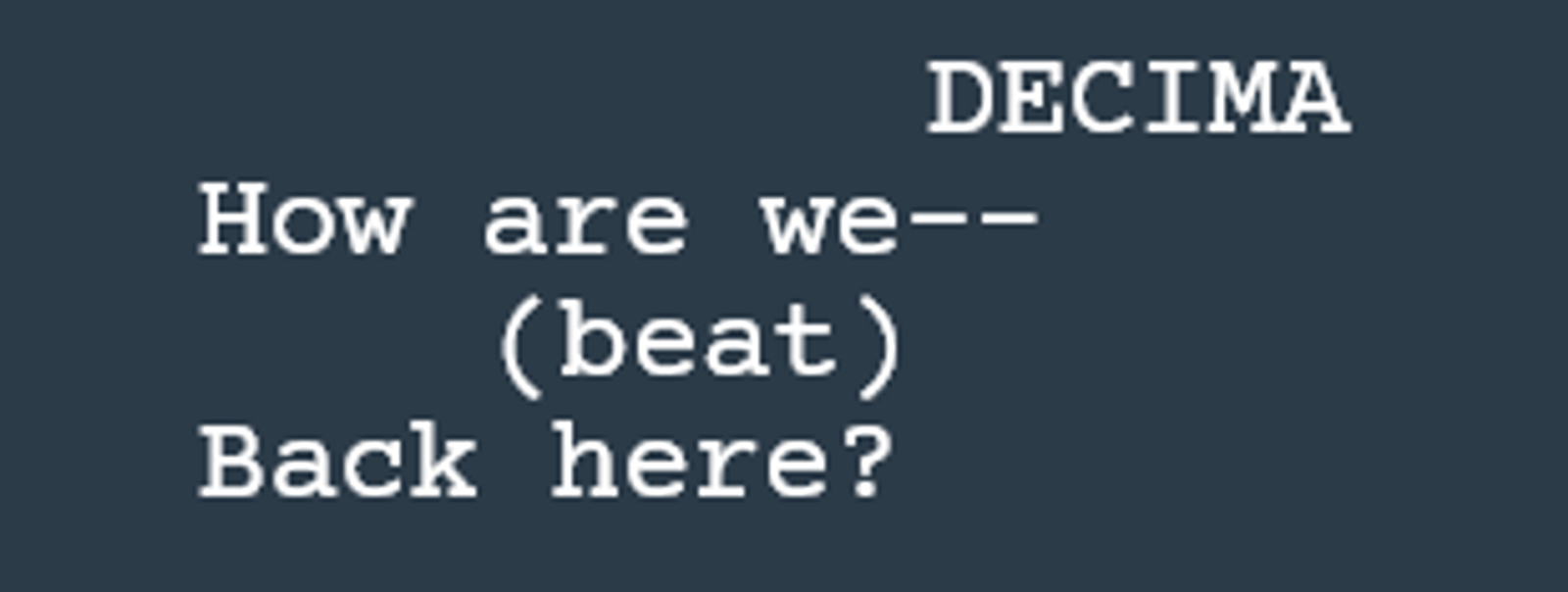
The final use of a parenthetical that I want to highlight today is the supremely useful "beat." This is a small word that a screenwriter will put in a parenthetical or an action block to indicate that there is a slight pause of silence. This can help pace out a long speech, or if something of significance was said, it allows the reader time to stew on it.
Here's one final example from the same screenplay:
Words of caution
As you can see, the humble parenthetical is a supremely useful tool for a screenwriter. It has many uses, many of which can be singular to the screenplay itself. However, in general, I would recommend a degree of caution regarding parentheticals for a few reasons. Here are three main things to be wary of:
- Keep your parentheticals brief. As you can see, all the parentheticals I've highlighted are usually one or two words. This is intentional. The last thing I want is for the reader to be distracted by the parenthetical. If anything, it should be invisible to them. Keep the actual content of your parenthetical as thin as you possibly can.
- Be sparing. A few parentheticals scattered around a script are totally fine, but there is a point where they become overbearing, and a reader might wonder why you can't communicate the information through other means. Overusing this tool can be a fatal error, so make sure you are prudent with your deployment.
- Be respectful of the actor. One of the main reasons parentheticals are sometimes maligned is that it dictates the actor's performance. Actors like screenplays because they have a lot of room for interpretation. A parenthetical removes that possibility. Keep your parentheticals brief, only use them when necessary, and make sure you don't stomp over an actor's enthusiasm by controlling them too tightly.
Conclusion
The parenthetical is an essential tool in the screenwriter's arsenal that can refine your script to perfection. If you bear my words of caution in mind, feel free to use this great tool to make your script as good as it can be.